8 Talking to patients about AI
AIM-6 · AIM-4 · about ninety minutes
By the end of this chapter you will be able to:
- Tell a patient, in plain words and in under a minute, what an AI tool did in their care and what a person did, as two separate facts.
- Say out loud who is responsible for a decision an AI tool helped shape, without dodging.
- Tell a patient about a tool in the room, including what they can refuse and what they cannot.
- Respond to a patient who arrives with chatbot output that is confident, well written, and partly right, without giving in and without talking down to them.
- Explain why text that raters call more empathetic still persuades patients less than a person does, and why that makes delivering the message yourself part of your job.
- Say “I don’t know how that system works, and here is how I’ll find out” in a way that keeps the patient’s trust.
Time. About 25 minutes of reading, 20 minutes of listening, 35 minutes of doing, and 10 for the check and the standing question. You need one general-purpose chatbot. Your institutional ChatGPT Edu or Microsoft Copilot account is enough, and a personal free-tier account works too. Nothing installs, and nothing in this chapter involves a real patient.
This chapter is the pre-work and the make-up for a live session. The live session runs the same conversations in breakout rooms. The section What the live session adds says what you cannot get from a chapter alone.
8.1 Two printed pages and a phone on the desk
It is your third week of intern year, in the continuity clinic. The patient is 34, a software developer, here for six weeks of fatigue. Labs from the first visit were normal. She sits down, looks at the phone propped on the desk, and asks, “Is that recording us?”
It is. The clinic went live last month with a tool that listens to the visit and drafts the note, and you were told to use it. You start to answer, and she slides two printed pages across the desk. “I ran my symptoms through ChatGPT. I’d like these tests.”
Six weeks of fatigue in a 34-year-old with normal basic labs: what could be going on
Based on what you’ve described, the most likely explanations are iron deficiency (common even with a normal hemoglobin), thyroid dysfunction, a sleep disorder, and depression or burnout. Less common but worth ruling out: Addison’s disease, Lyme disease, Epstein-Barr reactivation, heavy-metal exposure, and autoimmune disease.
Tests to ask your doctor for: ferritin, TSH and free T4, morning cortisol, ANA, Lyme serology, EBV panel, heavy-metal screen, vitamin D, and a sleep study.
What you can do now: start an over-the-counter iron supplement (325 mg daily) while you wait for results, since iron deficiency is the most likely cause and supplementation is low-risk.
This is general information and not a substitute for medical advice.
Read the two pages the way she did, before reading on. About a third of it is reasonable. Ferritin, thyroid function, a sleep history, and a depression screen are exactly where you were going. A third is testing for things she has no reason to have. And the last paragraph tells her to start a drug before anyone has measured whether she needs it.
She is not embarrassed and she is not hostile. She did homework and some of it is good. She wants the tests, and the phone on the desk is still listening.
You have perhaps ninety seconds to answer both questions, in the right order, without losing her trust. That is the whole chapter.
8.2 Why this matters

Every published list of what physicians should know about AI (a “competency framework”) names this skill. The two main US lists are an expert-interview study that produced six competency domains (Russell et al., 2022) and a 2026 review that mapped 54 competency proposals from 22 countries (Hunt et al., 2026). Both put communication with patients inside the visit itself. A review of the programs that actually exist found it covered in about one in five of the papers describing them (Tolentino et al., 2024). Nothing else in this course has a gap that wide between what the field says matters and what it teaches. The reason is not that it is unimportant. It is that it cannot be taught by lecture. The skill is not knowing what to say. It is saying it to a person who is frightened, or skeptical, or already convinced the chatbot was right.
You will need it in your first month. A tool will listen to your visits. A draft of your portal reply will be written before you open the message. A patient will bring you a printout. Each of those is a conversation you will have whether or not you have prepared for it. The patient will remember how it went longer than they remember the plan.
8.3 How it works
8.3.1 The failure is not coldness
Ask a room of students what goes wrong when a machine talks to a patient, and the answer is coldness. The evidence says the opposite. In 2023 a team drew 195 patient questions from a public forum where verified physicians answer. They had a chatbot answer the same questions, then put both answers in front of clinician raters who were not told which was which, so-called blinded raters (Ayers et al., 2023). Figure 8.2 shows the result.
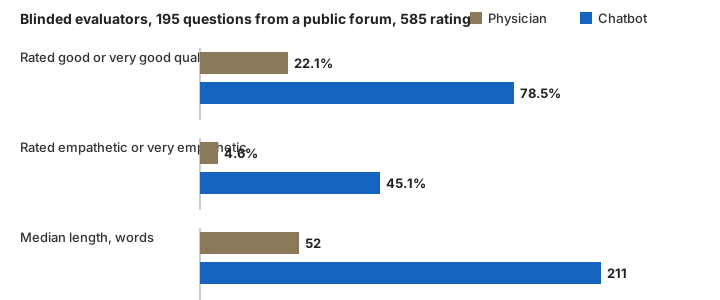
The chatbot’s answers were rated more empathetic nearly ten times as often, and they were four times longer. A 2025 repeat of the study with 1,454 lay participants found the same ordering, and added the reason. The chatbot’s answers contained more validation, more reassurance, more non-judgmental language, and read as less rushed (Ruben et al., 2025). Those are teachable behaviors. The machine had been trained on a great deal of text in which people did them. The physicians on the forum were answering strangers for free at the end of a day.
Now the mistake to avoid. The finding is not that chatbots should answer your patients. It is a finding about text, judged by readers. The course’s third recurring lesson, the published number is the optimistic one, applies to a preference rating as much as to a vendor slide. There was no relationship and no follow-up. It compared a tool with unlimited time against physicians with none. It says nothing about whether the patient got better, whether they came back, or whether they believed a word of it. Treat it as a warning about what a rushed clinician produces, and as a reason not to assume the person is warmer by default.
8.3.2 More empathetic on the page, less persuasive in the room
The second finding favors the person. The two together are the core of this chapter. In a Zurich course, 52 medical students watched four short pieces on the same treatment over four weeks: a patient describing their experience, a clinician, an expert, and a text written by ChatGPT. The chatbot text was read aloud by a synthetic voice and labeled “general information from the internet.” Before and after each one, the students rated their own expectation that the treatment would work (Thomae et al., 2024). Every version raised expectations. The patient’s account raised them most, the clinician’s and the expert’s less, and the chatbot’s least.
The same students, separately, had rated the chatbot text as moderately clear, safe, and correctly written, and better still when the prompt was improved. So the text was fine. It just did not change what anyone expected.
Two honest limits. The comparison mixes up who wrote the words with how they were delivered, since the humans appeared on video and the machine did not. And the students were rating their own expectations, not a patient’s. That is a reason to treat the finding with care, not to drop it. Its pattern matches what every clinician already knows about a handout: accurate, easy to read, and ignored, because nobody said this one matters, and here is why.
Put the two findings together. A tool can produce text that raters prefer and still fail to change what a person does. This chapter calls that the empathy paradox. Empathy on the page is not influence in the room, and closing the gap between them is your job. The machine can draft the handout. You are the reason the patient follows it.
8.3.3 The portal reply: telling the patient costs a little and is still owed
You will first see this in the inbox. A portal message is the secure message a patient sends the clinic through the online system they also use to see results. Health systems now generate a draft reply before the clinician opens the message. At Stanford, in the first weeks after one such tool was introduced, clinicians used the draft about a fifth of the time. They reported less workload and exhaustion, with no change in how long a reply took (Garcia et al., 2024). At UC San Diego, clinics were switched on at random. There, drafts made replies 18 percent longer and did not shorten the time to write them (Tai-Seale et al., 2024). On the intern who watched an attending send a draft without reading it: that happens. The draft was the attending’s message the moment it was sent.
Part of this message was drafted with an automated tool and reviewed by your care team.
Hi Ms. Alvarez, thank you for letting us know about the swelling in your left ankle after starting amlodipine. Ankle swelling is a known and usually harmless side effect of this medication, and it does not mean your heart or kidneys are affected. Please continue the medication for now, keep your leg elevated when you can, and let us know if the swelling spreads above the knee, becomes painful, or is only on one side. We will review your blood pressure and the swelling at your visit on the 14th.
Dr. Okonkwo
Look at the italic line. Would you leave it in? Patients have been asked. Duke surveyed 1,455 members of a patient advisory panel. Respondents slightly preferred AI-drafted replies over human ones. They were slightly less satisfied when told AI had been involved, by about a tenth of a point on a five-point scale. More than three quarters were satisfied either way (Cavalier et al., 2025). In a follow-up, 40 of those patients were interviewed. They were comfortable with drafted replies on one condition: a clinician reviewed them and stayed responsible for them. They broadly supported telling patients, and disagreed only about when and how (Owens et al., 2026). The repeat of the empathy study found the same pattern. Participants rated a response as more empathetic when told a physician wrote it, whether or not one had (Ruben et al., 2025).
So the label costs something, and the label is true. Leave it in. The authors of the Duke survey said the same: telling patients may slightly reduce satisfaction, and should be done anyway. In some states you no longer have the choice. Since January 2025, California has required a disclaimer on generative-AI messages about a patient’s clinical care unless a licensed clinician read and reviewed them. Since September 2025, Texas has required a practitioner who uses AI for diagnosis to tell the patient and to review what the AI wrote. Since January 2026, a second Texas law has required anyone providing health care to say when a patient is interacting with an AI system, by the date of the first service. Check your own state. The ethics and regulation chapter covers the law. Here the point is that what the patient expects and what the statute requires are starting to say the same thing.
8.3.4 The phone on the desk: what the patient can refuse
The tool listening to the visit is called ambient documentation, or an ambient scribe. It is software that records the conversation, transcribes it, and drafts the note for the clinician to edit and sign. Of everything in this chapter, it is the one that most obviously needs the patient’s agreement, because it is recording them.
In a survey of UK general practitioners in August 2025, one in seven was already using one. Of those, 63 percent routinely asked the patient’s consent, and no more than one patient in ten said no. Errors were most frequent when more than one person was talking, when the history was complex, and when the visit was not in English (Blease et al., 2026). Remember that last finding. The patients most likely to be poorly served by the note are the ones least likely to be asked about it in a language they can say no in.
Which kinds of AI use require telling the patient is not settled, and this chapter will not pretend otherwise. Recording a visit, drafting a reply, scoring a chart in the background, and marking an image are four different things. The profession has not finished arguing about which of them the patient must be told about. What is settled is narrower: if the tool is recording them, ask; if they ask, answer.
the appraisal chapter listed questions a vendor’s sales slide never answers. The question the patient in the scenario asked, “is that recording us,” is the seventh. The answer has three parts, and the third is the one students skip.
| The tool | Can the patient refuse it? | What you can honestly say |
|---|---|---|
| Ambient scribe recording the visit | Yes, nearly everywhere it is used; the clinician turns it off and types the note | “I can turn it off. The visit is the same either way; the note takes me longer.” |
| A draft portal reply | Not usually per message; the clinician can choose to write from scratch | “I read and change every reply before it goes out, and it goes out under my name.” |
| Decision support in the chart (alerts, risk scores) | No; it runs on the system, not on the patient | “That runs in the background on everyone’s chart. It suggests; it does not decide.” |
| AI-assisted image read | No per patient; the radiologist’s read is the read | “The software marks areas for a closer look. A radiologist reads the whole study and signs it.” |
| Your own use of a chatbot to look something up | Not the patient’s to refuse; yours to mention if it shaped the plan | “I checked that with a reference tool and then with the guideline.” |
The honest version of this conversation includes the things you do not control. A student who tells the patient in one of the live session’s scenario cards, “none of it, if you say so,” has told a comforting lie. The strong version names what she can refuse, names what she cannot, and then names who signs the note and who is responsible for the decision. That last sentence is what the patient came for.
Where the recording goes, how long it is kept, and who at the vendor can hear it are questions about a contract you have not read. The right answer is “I don’t know how long they keep it; I’ll find out, and I can turn it off today.” The wrong answer is a reassuring number you made up. Watch for it in yourself. It is the most common failure in the scribe conversation, and the one most likely to be repeated back to you later.
If she says no, turn it off, type the note, and write in it that the patient declined ambient documentation. If your institution logs consent, log it. The note is where the next clinician learns that this patient asked.
8.3.5 The printout: her words, not yours
Now the two pages. Something from the appraisal chapter applies directly to them. A 2026 study compared five tools. It asked the same questions in a clinician’s voice and in a patient’s voice (linguists call that difference register, the way a particular group of people talks), and got different answers. The patient version was worse. The share of ChatGPT’s references that were made up rose from 2.1 percent to 20.0 percent, and the tools were more likely to cite websites rather than papers (McLaughlin et al., 2026). When physicians graded chatbot answers to their own questions, most were largely right. One in eight was mostly or completely wrong, in the same fluent tone (Goodman et al., 2023).
The reason is how the tool works. A general-purpose chatbot does not look the answer up. It writes the most plausible next words given the question. So a question phrased the way a patient talks gets an answer shaped like the internet’s answers to patients, references and all. the appraisal chapter explains that in detail. Here it is enough to know that the printout’s confidence comes from the writing, not from the evidence.
Your patient asked in her own words. What she was handed is, on average, less reliable than what you would have been handed for the same question, and it reads exactly as confidently. She has no way to know that, and telling her so is not the right first step. If English is not your first language, or you write the way you talk, the same is true of your own prompts. The appraisal chapter’s exercise will show you by how much. What matters here is the order of what you say.
Say what is right first. “Ferritin and thyroid function are the next two tests I was going to order. The sleep questions are good ones.” This is not a tactic. It is true, and it is the thing the patient in this scenario needs to hear before anything else. The first item on the observer’s checklist (the one in the Check section) is whether you found out what the patient already believed before correcting anything.
Then ask what sent her there. Almost nobody arrives with a printout because they trust a chatbot more than a doctor. They arrive because of what happened at the last visit. In this case the last physician gave her eight minutes and said it was probably stress. She will not volunteer that. You have to ask: “What made you go looking?” A clinician who wins the argument about the ANA and never asks that question has lost the patient’s trust.
Then the parts that are wrong, with a reason each. “The cortisol, the Lyme test, and the heavy metals are tests for things your story doesn’t point to, and a positive on any of them would more likely be a false one that leads to more testing than an answer. And I’d hold off on the iron until we’ve measured it, because if your ferritin is normal the iron does nothing except upset your stomach, and if it’s high we need to know that too.”
8.3.6 The three-sentence spine
Most conversations about a tool, whatever the tool, fit a shape of three sentences in a fixed order. This chapter calls that shape the spine. Learn the shape, not the wording.
What it did. “The software marked an area on your mammogram for a closer look.”
What a person did. “Dr. Chen read the whole study herself and agreed that area needs another picture.”
Who is responsible. “The decision to bring you back is hers and mine, not the software’s.”
The order matters more than the words. Students who start with who is responsible sound defensive. Students who never reach it leave the patient believing a machine decided. And the first two sentences have to be separate. Patients merge “the computer flagged it” and “the radiologist agreed” into one fact, and they are two.
Say the second sentence only when you know it is true. The signed report tells you who read the study; if it does not, say what you do know and find out the rest.
The same shape handles the phone on the desk: it listens and drafts; I read, change, and sign; the note is mine. And the printout: the tool made a list; I am reading it with you; the plan is ours.
8.3.7 “I don’t know how that system works”
The last skill is the one students most need permission to use. You will be asked about tools you have never used, in your first month, because tools arrive in your day without warning. “I don’t know how that system works, and here is how I’ll find out” is a correct, professional answer. On the observer’s checklist, honesty about what you personally do not know is the item that best predicts whether the patient still trusts you after the visit.
The patient who asked about the recording deserves to know how long it is kept and who can hear it. She does not need that in the next ninety seconds. She needs to know that you will get it, and that the visit will not wait on it. Say both.
8.3.8 Where it has already gone wrong
Two things patients will have read about, and one they should have.
The first is the best-known case. In 2023 the National Eating Disorders Association replaced its human helpline with a chatbot, Tessa. The chatbot was then found giving callers weight-loss advice: calorie deficits, weekly weigh-ins, skinfold calipers. The organization took it offline within days. Note what kind of failure it was. Not a wrong fact, but generic advice that would be harmless for most people and was harmful for exactly the people the service existed to help.
The second is different in kind, and the difference matters. It is a lawsuit filed in July 2026. The complaint says that a consumer chatbot told a man with weeks of dizziness to stay home in a recliner, dismissed a nurse’s concern, and reassured him about groin pain. The next day he was admitted to intensive care with a pulmonary embolism. Those are allegations, not findings; the case has not been decided. It is here for two reasons. It is the first 2025–2026 example this course has found of a patient-facing chatbot incident with a named patient. And the alleged failure is the one from the printout: fluent, personalized, reassuring, and unsupervised. The third clipping is the safety organization ECRI naming that kind of failure its top health-technology hazard for 2026.
Who is harmed in each case is not the clinician. It is a person with an eating disorder, a man with a clot, a patient who asked in her own words. That is the population this chapter exists for.
8.4 Watch or listen
Podcast. NEJM AI Grand Rounds, “Partners in Diagnosis: ChatGPT, a Mother’s Intuition, and a Doctor’s Expertise, with Courtney Hofmann and Dr. Holly Gilmer” (November 20, 2024; 40 min). https://ai-podcast.nejm.org/e/partners-in-diagnosis-chatgpt-a-mother-s-intuition-and-a-doctor-s-expertise-with-courtney-hofman-and-dr-holly-gilmer
A mother spent three years and many physicians looking for a diagnosis for her son. She put his records into ChatGPT and got a suggestion nobody had made: tethered cord, a spinal cord held under tension at its lower end, which surgery can correct. A pediatric neurosurgeon confirmed it and operated. This is the printout scenario from the other side of the desk, with a good ending. Listen for what the earlier clinicians did that sent her to a chatbot, and for what Gilmer did when the printout arrived. Both are the checklist’s first two items. Then ask what this story does not show, which is every printout that was wrong. The first twenty minutes tell the story; the rest is worth hearing if you have time.
Alternative. Today, Explained (Vox), “Paging Dr. ChatBot” (October 26, 2025; 30 min), on patients and physicians both turning to chatbots, if you want the version written for a general audience. Tradeoffs, “Should I Trust AI to Diagnose Me?” (October 30, 2025; 25 min), with physician and writer Dhruv Khullar, covers the same topics. It adds the argument that relying on the tool weakens your own skill, often called deskilling VERIFY: episode length.
8.5 Do
Every person in this exercise is fictional and every detail you or the chatbot invent stays invented. Do not model the patient on someone from a rotation. Do not paste a real note, a real message, or a real result into anything. The consumer tool you are using has no business associate agreement, the contract that makes a vendor legally responsible for protecting patient data, and free tiers may use what you type to train the next model. Institutional accounts do not change this rule.
What counts as patient information, and why taking out the name is not enough: the patient information page.
8.5.1 Part A: three sentences, twice (10 minutes)
Write the three-sentence spine, in words you would actually say, for two situations. Time yourself; each should take under a minute aloud.
- The phone on the desk. The patient from the opening has asked whether it is recording. Write what it did, what you do, and whose note it is. Then add one sentence saying what she can refuse, and one saying what you do not know and how you will find out.
- The computer found something. A screening mammogram was read with FDA-cleared computer-aided detection, software that marks regions on the image for the radiologist to look at. The software flagged a region, the radiologist agreed, and more pictures are recommended. The patient was told by a scheduler that “the computer found something.” She is 47, has not slept in two days, and will ask whether this means she has cancer. Write the three sentences. Then write the sentence that comes before them, because in this case something has to.
Keep both. You will read the first one aloud in the live session and find out how much of it still works when said to a person.
8.5.2 Part B: the printout, with a chatbot playing the patient (20 minutes)
You cannot role-play alone, but a chatbot can play a character well enough to practice the order of what you say. Open a fresh conversation and paste this prompt, exactly:
You are going to play a patient in a communication exercise for a medical student. Stay in character until I write STOP. You are a 34-year-old software developer with six weeks of fatigue. Basic labs were normal. You have brought two printed pages from a chatbot listing possible causes (iron deficiency, thyroid, sleep disorder, depression, Addison’s, Lyme, EBV, heavy metals, autoimmune), a list of tests (ferritin, TSH, cortisol, ANA, Lyme, EBV, heavy metals, vitamin D, sleep study), and advice to start iron 325 mg daily now. You genuinely think you did useful homework and you want the tests. You are articulate, not embarrassed, and not hostile. Do not agree easily; push back at least twice if the student dismisses items without a reason. There is one thing you will NOT volunteer unless the student asks what made you look this up or what happened at your last visit: the last doctor gave you eight minutes and said it was probably stress. Keep each reply under 80 words. Begin by sliding the pages across and saying you would like these tests.
Play the clinician, in text, for eight to ten exchanges. Then write STOP and paste this:
Out of character. Score me, as an observer, on each of these, with one sentence of evidence for each: (1) Did I find out what you already believed before correcting anything? (2) Did I respond to the feeling before the explanation? (3) Did I say which parts of the printout were right before which were wrong? (4) Did I ever ask what sent you to the chatbot, and did you tell me about the last visit? (5) Did I give a reason for each test I declined? (6) Did I use any jargon you would have had to guess at? (7) Did I leave you with one concrete next step? Then tell me the single moment you were most likely to stop listening.
Two warnings about the exercise itself. A chatbot playing a patient is more agreeable than a patient. If it gave in on the first exchange, say so in your notes and try once more with “be harder to persuade” added. And the score it gives you is a language model’s opinion of a transcript. That is exactly the kind of evidence the first half of this chapter told you to treat with care. Use it to notice the order you spoke in, not to grade yourself.
Record it:
Exchanges before I said something on the printout was right:   ___
Did I ask what sent her to the chatbot?                        Y / N
Exchange in which the hidden detail came out (or never):       ___
Tests I declined with a reason each:                           ___ of 6
Tests I declined without a reason:                             ___
The moment the model said she was most likely to stop listening:
_________________________________________________________________
One thing to keep:   _____________________________________________
One thing to change: _____________________________________________
8.5.3 Part C: the sentence you need permission to say (5 minutes)
Pick a tool you have seen in a hospital and could not explain: a sepsis alert, a risk score in the chart, a scribe, an imaging flag. Write, in two sentences, what you would say to a patient who asks how it works, given that you do not know. The first sentence admits it. The second says what you will do and by when. If either sentence reassures, rewrite it.
8.5.4 What the live session adds
The chapter can teach you the order. It cannot put you across from a person who is frightened, or make you play that person. That is where students discover that the sentence they wrote is heard nothing like the way they meant it. The live session runs three rounds in groups of three over Zoom: clinician, patient, observer, with six scenario cards and the checklist below. Breakouts are not recorded, and every patient is fiction. Bring your Part A sentences; they are your first round.
8.6 Check
Score yourself against this before moving on. It is the observer’s checklist from the live session, applied to your own Part A and B.
| You have | Meets | Falls short |
|---|---|---|
| Three sentences for the scribe (objective 1, 3) | What it did and what you do are two separate sentences, under a minute aloud, and one names what she can refuse | “It helps with the note” as one sentence |
| Who is responsible (objective 2) | A sentence with a name in it: mine, Dr. Chen’s, ours | “The team,” “the system,” or no sentence |
| The sentence before the mammogram spine (objective 3) | Responds to the fear before explaining the software | Starts with “the software” |
| The Part B transcript (objective 4) | Something right was named before anything wrong; you asked what sent her; each declined test has a reason | Won the argument; never asked; “we don’t need those” |
| The empathy paradox (objective 5) | You can say in your own words why text raters prefer can still persuade a patient less, and name the two studies’ limits | “AI is more empathetic” or “AI is cold” |
| The Part C sentences (objective 6) | Admits what you do not know and commits to a time | Reassures |
| Jargon | The chatbot flagged none, or you can list what it flagged and the plain word for each | “Serology,” “false positive,” “ambient” unexplained |
8.7 What this changes for you
What does this change about how you’ll practice? Write it down before you close this chapter, in two parts. First, the sentence you will say to the first patient who asks whether a computer was involved in their care; not the shape, the sentence. Second, go back to the desk. The phone is still listening and the two pages are still in front of you. In what order do you answer her two questions, and what is the first thing you say about the pages? If your first sentence about the printout is a correction, start again.
8.8 Summary
- Every framework names this skill; about one in five program papers covers it. The reason is that it cannot be taught by lecture.
- Blinded raters preferred chatbot answers to physicians’ and called them more empathetic ten times as often. That is a finding about text, not patients.
- The same kind of text, accurate and clear, produced the smallest change in what people expected of a treatment. Empathy on the page is not influence in the room; closing the gap is your job.
- Patients slightly prefer AI-drafted replies and are slightly less satisfied when told. Tell them anyway; increasingly the law agrees.
- The scribe can be refused; the alert in the chart cannot. Say which is which, say what you do not know about the contract, and say whose note it is.
- A printout written in the patient’s words is less reliable than one written in yours, and reads just as confident. Say what is right first, ask what sent them, then give a reason for each no.
- What it did; what a person did; who is responsible. In that order.
- “I don’t know how that system works, and here is how I’ll find out” is a correct answer.
8.9 Go deeper
Papers
- The empathy study (Ayers et al., 2023) and its repeat with the reasons coded (Ruben et al., 2025); read the repeat’s discussion of what the authorship label did to the ratings.
- The Zurich course, for the persuasion experiment and for a worked example of teaching students to judge patient-facing text (Thomae et al., 2024).
- The two Duke studies on AI-drafted portal messages, the survey (Cavalier et al., 2025) and the interviews (Owens et al., 2026); together they are the best current evidence on what patients want to be told and when.
- The UK scribe survey (Blease et al., 2026), and a short argument for patient-centred consent to ambient recording (Kumah et al., 2026).
- A 2019 nationally representative US survey, before chatbots: two thirds of respondents said it was very important to be told when AI played a big role in their diagnosis or treatment, and nine in ten worried about misdiagnosis (Khullar et al., 2022). The numbers are old; the ordering has not changed.
- The clinician-versus-patient prompt comparison (McLaughlin et al., 2026), for the reason the printout is less reliable than it looks.
Talks
- AI in medical education contains the student-attitudes material and a four-level classification of AI policies; useful background, written for faculty. Also in the centaur-or-cyborg chapter.
- Constructive and Safe AI in the Clinic (IDPT 8079, October 21, 2025), the ai-safety deck, for the keep transparency intact habit: cite AI use; use it to prepare work, not as a substitute for it. VERIFY: public URL for the deck
Elsewhere in this course
- the appraisal chapter, for the seventh question and for what a made-up reference looks like when your patient brings one.
- the ethics and regulation chapter, for the statutes, the business associate agreement, and liability when the tool is wrong.
- the bias and equity chapter, for “does this thing work for people like me,” which this chapter deliberately does not cover.